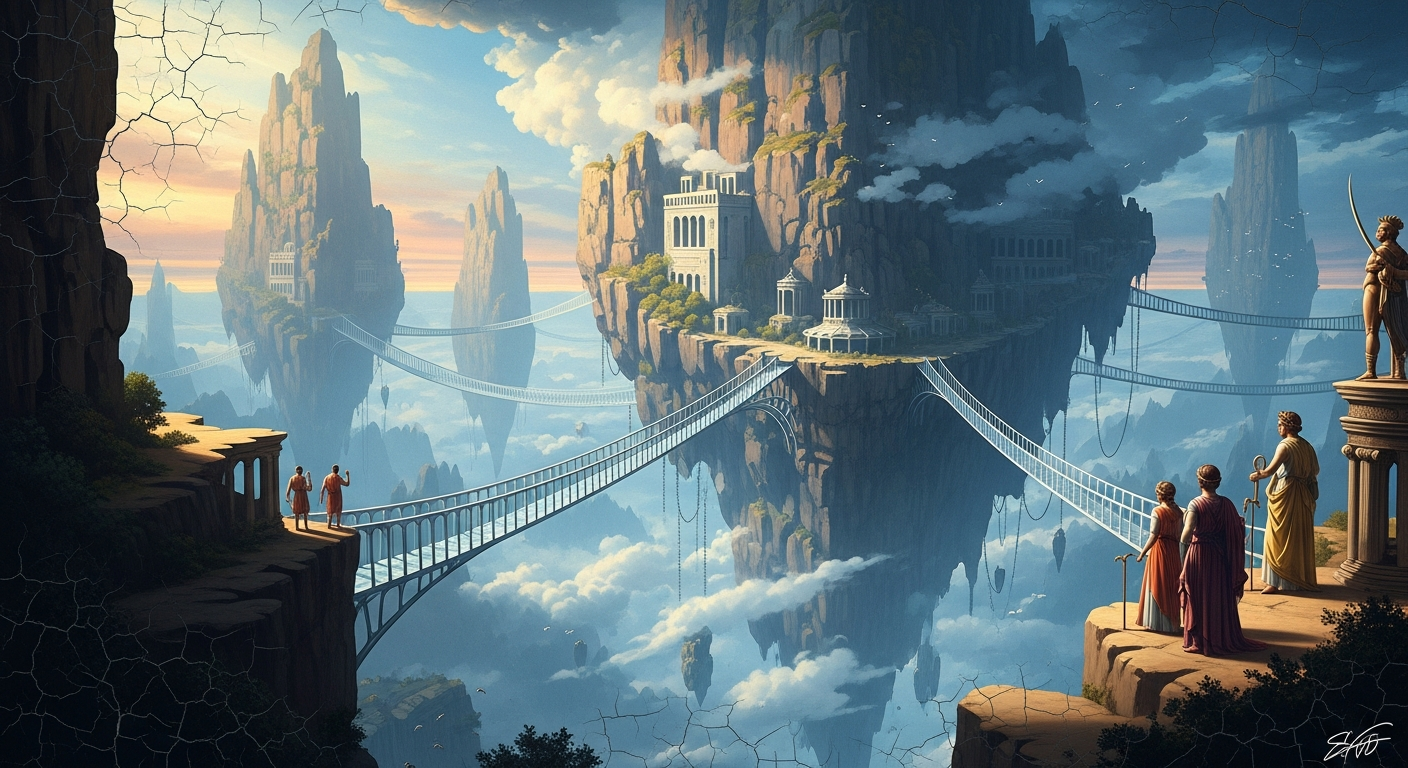
The confluence of classical artistic technique and modern fantastical subject matter often yields images of profound beauty and dramatic power. Our envisioned masterpiece, a Grand fantasy landscape depicting immense floating islands connected by translucent crystalline bridges, observed by detailed mythological figures, is a prime example of this powerful synthesis.
Style and Technique: The Renaissance Revival
The core choice of the ‘Renaissance Oil Painting style’ is crucial. This shifts the interpretation from a bright, modern digital rendering to a work steeped in historical gravity.
The emphasis on ‘dramatic chiaroscuro lighting’ is fundamental to this period, perfected by masters like Caravaggio. Chiaroscuro—the extreme contrast between light and dark—serves not only to illuminate the central subjects but also to build profound emotional tension, making the light that catches the crystalline bridges appear almost divine against the deep, dark voids surrounding the floating landmasses.
To ground the image in authenticity, the request for a ‘cracked canvas texture’ suggests age and permanence, elevating the digital creation to the status of a revered historical artifact. Coupled with ‘high dynamic range’ and ‘masterpiece quality,’ the execution is visually stunning, capturing every intricate detail of the foreground figures and the immense scale of the islands.
Subject Matter: Worlds Adrift
The landscape itself is defined by three key elements that push the boundaries of epic fantasy:
- Immense Floating Islands: These colossal landmasses evoke worlds adrift, challenging the viewer’s perception of gravity and reality. Their sheer size underscores the ‘Grand fantasy’ aspect, suggesting an epic narrative far beyond human scope.
- Translucent Crystalline Bridges: These delicate, shimmering links introduce a vital tension. While the islands are heavy and grounded, the bridges are ethereal and fragile, symbolizing perhaps the fleeting connection between the mortal and the divine, or the triumph of elegant engineering over vast cosmic distances.
- Detailed Mythological Figures: Positioned in the foreground, these observers—perhaps muses, gods, or heroes—act as proxies for the viewer. Their detailed rendering and mythological context connect the scene to established narratives of creation and exploration, suggesting that even divine beings are awestruck by this aerial vista.
Conclusion
This artwork is more than just a fantasy scene; it is a meditation on scale, divinity, and the mastery of light. By forcing the dramatic lighting and rich textures of the Renaissance onto a conceptual high-fantasy landscape, the resulting image achieves a timeless quality, inviting viewers to explore a world that feels simultaneously ancient and infinitely imaginative.