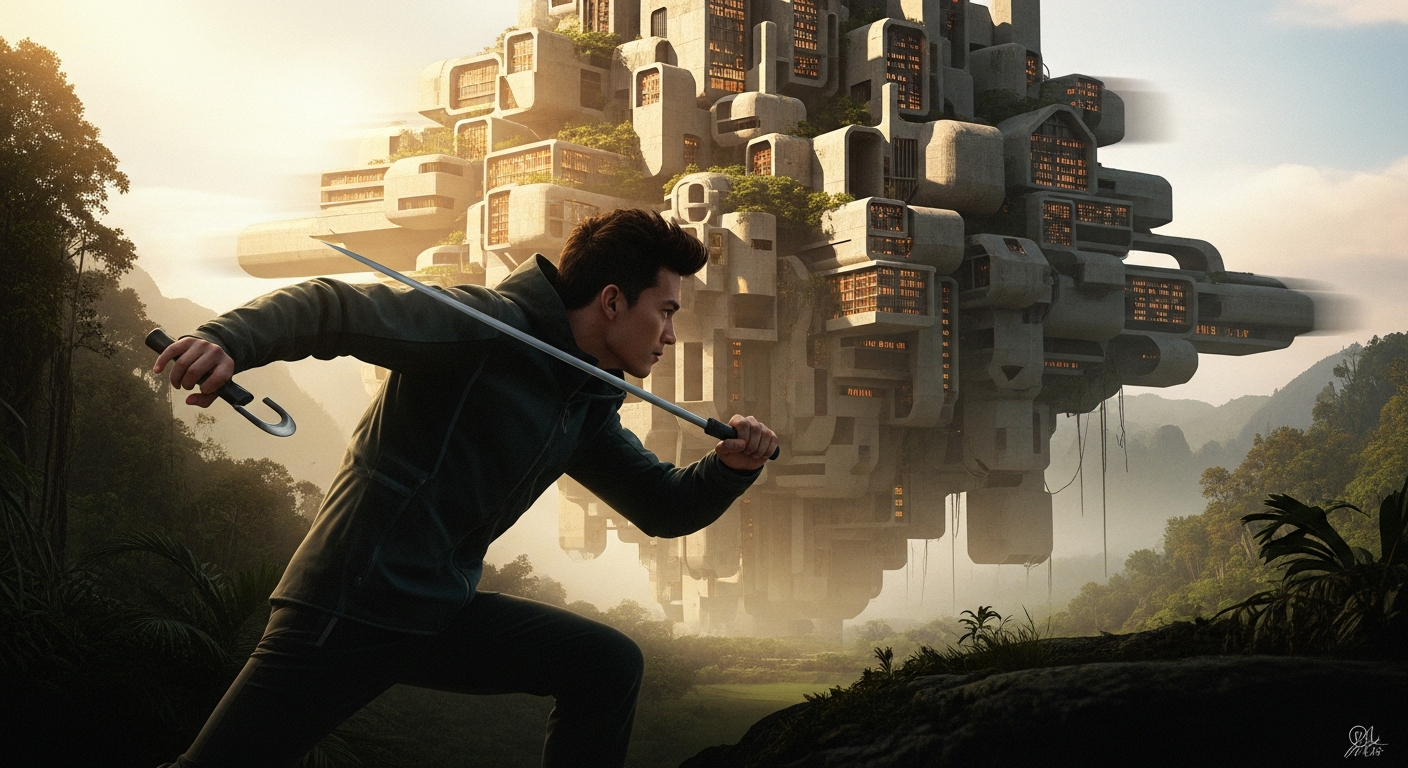
Across the vast landscape of ancient mysteries, few remnants defy logic and conventional history like the Aethelian Archive. Shrouded in perpetual high-altitude mist above the uncharted peaks of the Alarian Plateau, this colossal structure is not merely old—it is an architectural paradox. It is a gravity-defying monument of pure, unadorned concrete, built in the severe style we recognize today as Brutalism, yet predating its modern resurgence by millennia. This pseudo-documentary investigation delves into the chilling lore and enigmatic legacy of the Aethelian civilization, the architects who dared to build the first, and possibly last, floating Brutalist library.
The Discovery and Architectural Shock
The Archive was first documented in the early 1970s by aerial surveyors exploring meteorological anomalies. What they captured on grainy film was staggering: an impossible mass of raw, geometrically rigorous concrete blocks, seemingly weightless, suspended thousands of feet in the air. Estimates suggest the Library spans three cubic kilometers, its textured surface scarred by time and elemental abuse, yet structurally immutable.
The initial shock lay in the style. Brutalism—a philosophy emphasizing functionality, truth to materials (raw concrete), and a monumental, often forbidding scale—is typically associated with mid-20th-century socio-political movements. Finding this aesthetic perfected by a civilization that vanished during the Bronze Age rewrote established timelines. Scholars hypothesize that for the Aethelian people, Brutalism was not an aesthetic choice, but a spiritual and practical necessity.
The Aethelian People: A Cult of Pure Logic
The Aethelians were not warriors or hedonists; they were knowledge zealots. Lore suggests their society was structured around the absolute pursuit and preservation of empirical truth, rejecting emotion, decoration, and anything that compromised logical rigor. Their civilization lasted only 400 years, characterized by rapid technological advancement and profound intellectual isolation.
For them, the Brutalist style perfectly embodied their philosophy:
- The raw, exposed concrete symbolized honesty and permanence.
- The monumental scale represented the infinite scope of knowledge.
- The lack of ornamentation rejected the frivolous distractions of the sensory world.
The Library was not meant to be beautiful or inviting; it was meant to be eternal, efficient, and intimidating—a fortress against ignorance.
Engineering Marvels: The Secret of Levitation
How does a structure of such immense density float?
Analysis of recovered architectural fragments suggests the Aethelians employed a sophisticated form of sonic levitation technology, powered by resonating matrices embedded deep within the concrete aggregate. This crystalline aggregate, possibly a mineral found only in the Alarian Plateau, was meticulously organized to create low-frequency anti-gravitational fields, locking the massive structure into a fixed, perpetual orbit.
Furthermore, the structure is designed to function as an immense atmospheric regulator. Its minimal windows and thick walls were crucial for isolating the stored knowledge from external variables, ensuring perfect temperature and humidity control—an early, massive, and floating server room dedicated entirely to preserving crystallized thought.
Inside the Archive: Knowledge in Crystal and Silence
Gaining access to the Archive is perilous. Internal chambers are vast, echoing, and eerily silent. The Aethelians did not use perishable materials like papyrus or vellum. Instead, knowledge was stored in massive, translucent silica prisms, organized on floor-to-ceiling concrete shelves. Each prism holds vast amounts of highly compressed data, perhaps readable only through bio-luminescent touch or specialized sonic decryption devices.
The interior design is the epitome of cold utility: long, stark corridors; immense, uninviting reading platforms; and central processing chambers where the crystal matrices are maintained. Visitors report a pervasive sense of intellectual weight—the realization that they stand within the accumulated wisdom, triumphs, and failures of an entire civilization, rendered in the coldest, most enduring material imaginable.
Conclusion: A Monument to Hubris?
The floating Brutalist Library remains suspended, a silent, imposing guardian of forgotten secrets. Did the Aethelians flee the world, elevating their knowledge to keep it safe? Or did their relentless pursuit of pure logic lead to a catastrophic societal collapse, leaving the Archive as a chilling monument to intellectual hubris?
The Library is a paradox: an ancient ruin designed to withstand eternity, a testament to a civilization that perfected an architectural style thousands of years ahead of its time. The Archive is open, waiting for those brave enough to decode the silence held within its raw concrete walls.