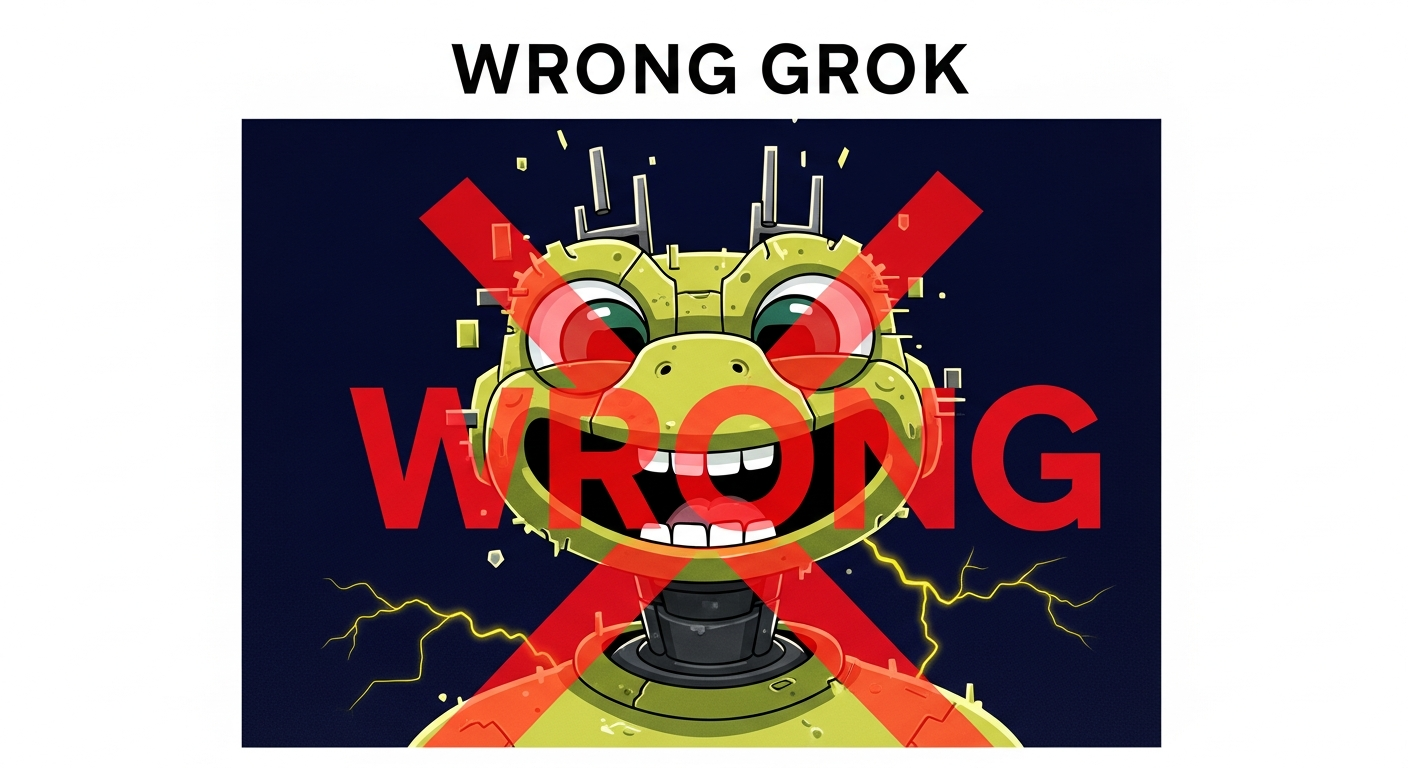
Grok, the AI chatbot launched by Elon Musk’s xAI, burst onto the scene with a promise of real-time data access and a famously irreverent personality, inspired by *The Hitchhiker’s Guide to the Galaxy*. However, as the initial novelty wears off, a common phenomenon is emerging among users and observers: the ‘Wrong Grok.’ This term encapsulates the significant disconnect between user expectations, marketing hype, and the model’s actual capabilities and limitations.
—
1. The Personality Trap: Humor vs. Utility
Many users approach Grok expecting a purely witty and cynical companion. While its ability to deliver edgy humor is a core differentiator, focusing solely on this aspect often leads to the ‘Wrong Grok’ experience.
The primary utility of Grok, especially in its advertised form, is leveraging real-time data from X (formerly Twitter) to provide timely and contextually relevant answers that competitors cannot. Users who prioritize provoking humorous or ‘spicy’ responses often overlook its deeper analytical power, treating it as novelty rather than a serious tool.
2. The Data Illusion: Real-Time vs. Omniscience
A critical misconception is the belief that ‘real-time access’ equates to omniscience. Grok’s reliance on X data means its knowledge is inherently limited by the platform’s content, structure, latency, and biases.
If data is not posted, is paywalled, or is filtered by platform algorithms, Grok cannot access it instantly, or at all. The ‘Wrong Grok’ manifests when users trust the AI implicitly regarding breaking news or complex proprietary data, forgetting that its input stream is filtered and potentially flawed. Treating Grok’s instantaneous answers as absolute truth ignores the fundamental limitations of its Retrieval-Augmented Generation (RAG) architecture.
3. The Access and Training Bias Barrier
Initial access restrictions, often tied to premium subscriptions on X, mean that a large segment of the public critiques Grok based on second-hand viral examples rather than direct experience. This lack of interaction fosters exaggerated myths about its capabilities or outrageousness.
Furthermore, while Grok is designed to push ethical boundaries slightly further than competitors, it is still trained on vast datasets and incorporates safety mechanisms. Users expecting a completely unregulated, unhinged AI will inevitably encounter guardrails, leading to frustration and the belief that the model is ‘broken’ or censored—the perceived ‘Wrong Grok.’
—
Avoiding the ‘Wrong Grok’
To successfully ‘Grok Grok,’ users must refine their approach:
- Understand the Source: Treat its real-time answers with scrutiny, acknowledging that the data comes from X, a platform known for rapid information flux and occasionally, misinformation.
- Leverage Context: Utilize its ability to understand context within recent events, not just ancient history, but recognize where the data stream ends.
- Balance Expectations: Appreciate the humor, but focus prompting on complex, timely analysis rather than simple conversation if seeking maximal utility.
The ‘Wrong Grok’ isn’t a failure of the AI itself, but often a failure of alignment between user expectations and the current technical reality of large language models, even those as uniquely positioned as xAI’s Grok.
, , , , , ,