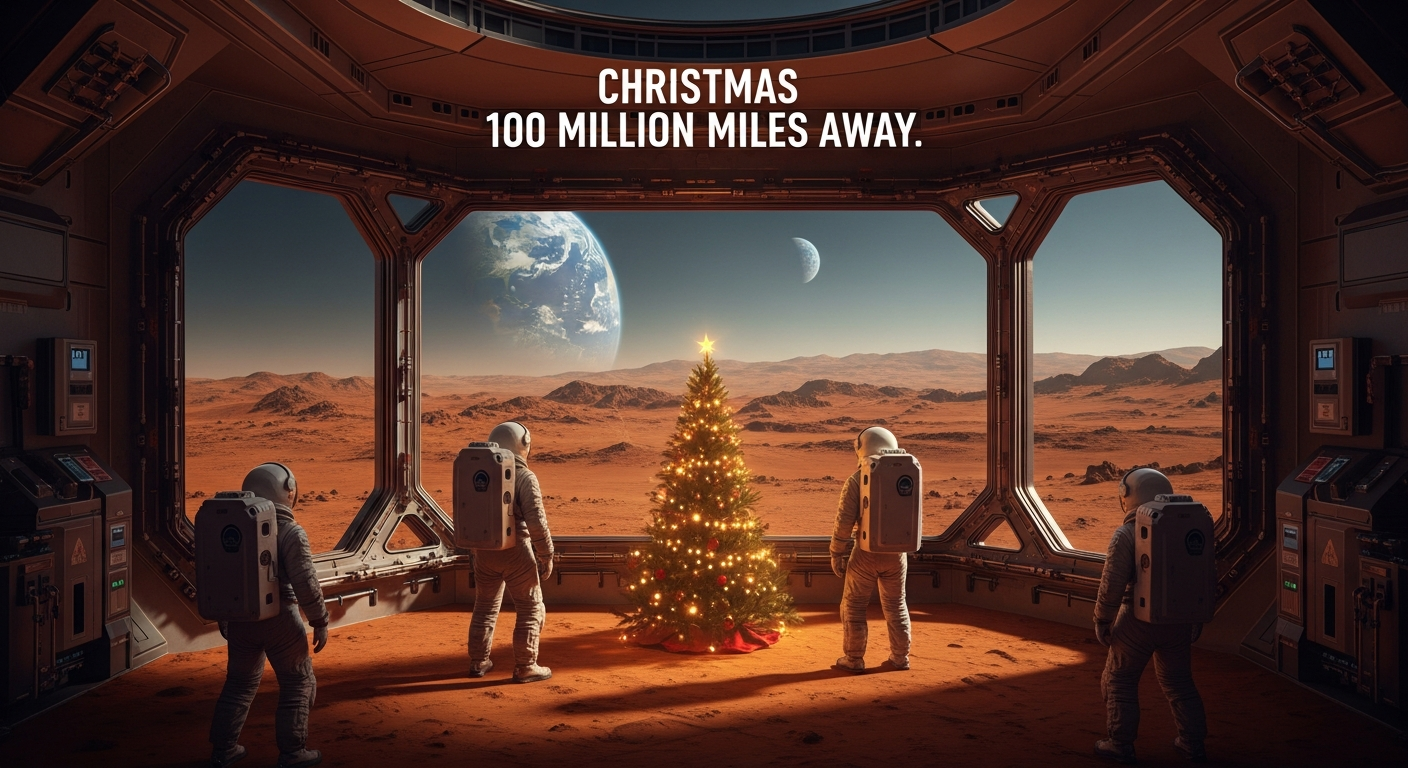
Christmas Eve on Earth is marked by bustling streets, twinkling lights, and family gatherings. But imagine celebrating it 100 million miles away, within the sterile confines of a pressurized habitat nestled against the rusty canyons of Mars. This is the reality explored in “A Martian Christmas Eve,” a short film capturing the profound isolation, ingenuity, and resilient spirit of the first human settlers on the Red Planet.
The Setting: Sol 587 and the Spirit of Home
The Ares VI crew is nearing the end of its long-duration mission. Outside the thick, radiation-shielded walls of their Hab, the landscape is silent, dominated by the dusty ochre expanse and the thin pink sky.
Inside, however, a determined effort has been made to evoke the warmth of Earth. Decorations aren’t store-bought; they are meticulously 3D-printed ornaments—miniature rockets, tiny terrestrial snowmen, and the ever-present blue marble of Earth, hung on a small, synthetic Christmas tree grown for ambiance rather than sustenance.
Adapting Earth Traditions for Martian Life
A traditional Christmas dinner is impossible, but the astronauts are pioneers of culinary adaptation. Instead of roast turkey, the meal features carefully rationed, freeze-dried delights supplemented by fresh produce from the Hab’s hydroponic garden—perhaps a few crisp lettuce leaves or even a rare Martian-grown potato. The act of sharing this meticulously prepared meal becomes a sacred ritual, a reminder of bounty and life sustained against incredible odds.
Gift-giving is the most poignant adaptation. Since physical gifts from Earth stopped arriving months ago, gifts are purely symbolic or practical. Perhaps a handwritten letter detailing a favorite memory, a newly coded software update for the rover, or a poem composed during solitary hours looking out at Phobos and Deimos. The value is not in the material item, but in the effort, thought, and connection it represents.
The Long-Distance Call: The 15-Minute Delay
The emotional centerpiece of the evening is the effort to connect with loved ones back on Earth. A video call is scheduled, but the immense distance imposes a brutal reality: a communication lag of up to 15 minutes each way. There is no real-time conversation, only delayed monologues. An astronaut might ask a spouse how their day was, knowing the answer won’t arrive until after midnight on Mars. This lag underscores the sacrifice, turning the joyous attempt at connection into a bittersweet performance of affection separated by astronomical distance.
Looking Out: The Ultimate Perspective
As the Martian Christmas Eve draws to a close, the film captures a quiet moment. The crew gathers at the observation dome, not to look at the familiar stars, but to find the one star that means everything: Earth. It’s a distant, shimmering pale blue dot, a beacon of civilization, family, and home.
In that moment of profound perspective, the astronauts understand their mission is not just scientific, but foundational. They are forging a new tradition, celebrating resilience and humanity’s ability to carry hope and celebration to the very edges of possibility. “A Martian Christmas Eve” is more than just a holiday story; it is a testament to the enduring power of human connection, celebrated even when separated by a cosmic ocean of 100 million miles.
,,,,,,