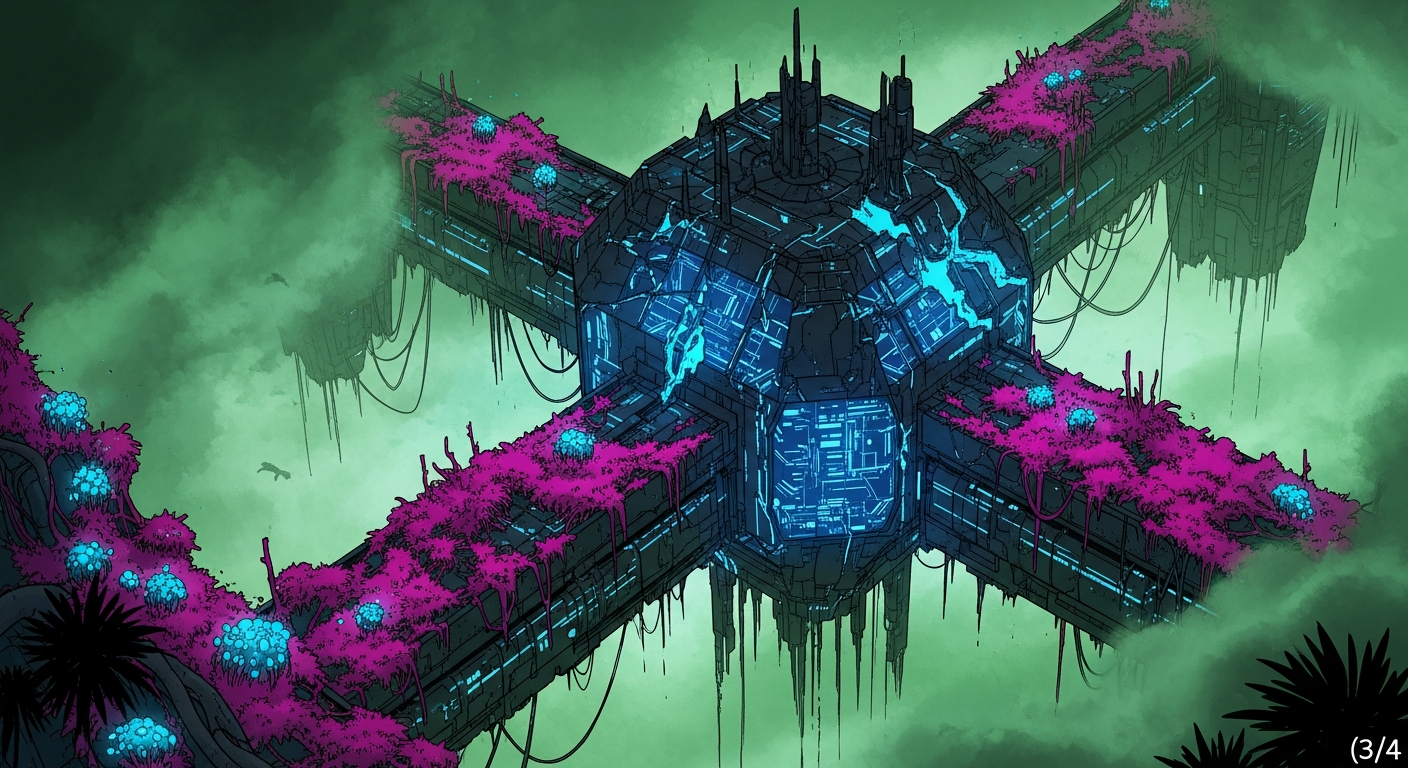
The Ghost of Humanity’s ReachIn the sprawling catalog of dystopian futures, few images evoke as much melancholic grandeur as the derelict megastructure. Our focus is the ‘Orbital Tether Anchor Station,’ a towering ruin submerged beneath a heavy, toxic green atmospheric smog. Once the proud anchor of humanity’s greatest vertical transport system—the space elevator—it now stands as a monument to catastrophic failure and environmental reclamation.## A History Lost to the HazeThe Anchor Station, codenamed ‘Ares Prime,’ was designed to handle the massive kinetic stresses of the tether connecting the planet Obsidia to its geostationary counterpart. Its structure, primarily composed of hardened obsidian plating, was intended to be impervious to both orbital debris and corrosive atmospheric conditions.However, the current visual tells a different story. The station appears to have succumbed not to sudden external attack, but to a slow, inevitable internal decay, exacerbated by the planet’s relentless, exotic ecology. The prevalent green smog, likely a result of industrial collapse and rampant bioweaponry or failed terraforming, now serves as a perpetual shroud, lending an eerie, subterranean feel to the colossal tower.## The Invasion of the Neon JungleWhat truly defines this scene is the vibrant, aggressive life force reclaiming the structure. Bioluminescent neon jungle flora has rooted deeply into the Anchor Station’s infrastructure. These glowing, symbiotic organisms creep across the cracked obsidian, their light filtering through the dense smog, creating stark contrasts and dramatic volumetric shafts. This organic invasion highlights the immense passage of time since the station was active, proving that even humanity’s most robust creations are temporary.## The Visual Language: Circuitry and ScaleThe cracked obsidian plating reveals the station’s core—intricate, exposed circuitry that still pulses with a faint, internal glow. This juxtaposition—natural life aggressively conquering advanced technology—is central to the piece’s narrative tension.The sheer scale of the structure is amplified through the use of a tilt-shift effect, a technique that typically turns real-world objects into hyper-real miniatures. Applied here, it confuses the viewer’s sense of scale, making the colossal tower feel both incredibly vast and intimately detailed, emphasizing its isolation in the murky expanse.## Artistic Synthesis: Kuciara and StålenhagThe requested artistic direction draws upon two masters of modern sci-fi art. Maciej Kuciara’s influence is evident in the highly detailed, gritty presentation of hard surface structures and industrial decay. His expertise ensures the cracked plating and intricate circuitry possess a believable level of complex engineering. Conversely, the pervasive melancholy, the dynamic, naturalistic atmosphere, and the integration of advanced structures into a recognizable, yet deeply alien landscape are hallmarks of Simon Stålenhag. The resulting synthesis is a digital painting that captures both the polished, hard-edged aesthetics of cyberpunk and the quiet, pervasive tragedy of retro-futurism.
, , , , , , , , ,