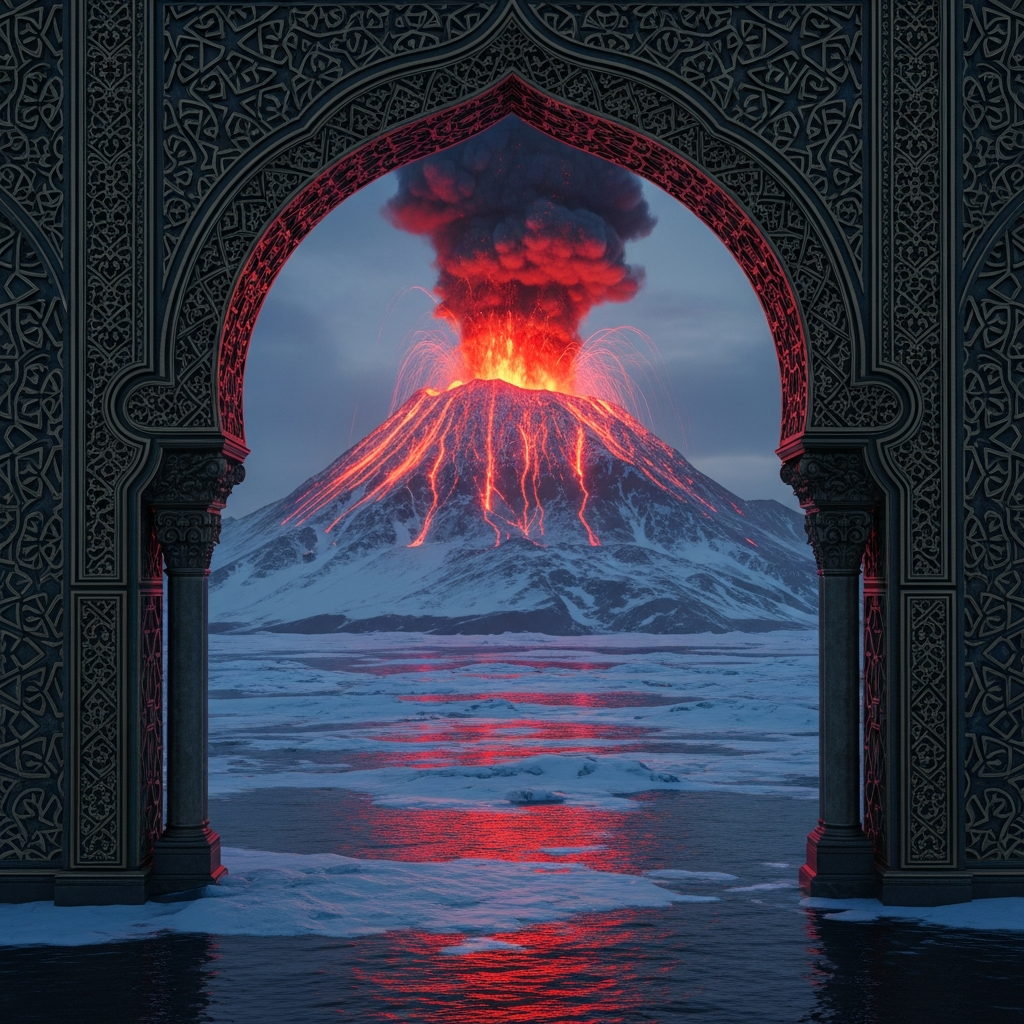
The artistic prompt—a volcanic mountain erupting at dusk, set against a snowy ocean backdrop, rendered in the intricate style of Spanish Mudejar Woodwork with a focus on velvet texture—is far more than a maximalist exercise. It is a profound philosophical statement on aesthetic tension, deliberately forcing disparate, often contradictory, elements into cohabitation to compel the viewer to re-evaluate traditional artistic boundaries.
Section I: The Juxtaposition of Elements
The core tension lies in the subject matter: raw, destructive, incandescent heat (the volcano) confronting frozen, still, impenetrable cold (the snowy ocean). Eruptions symbolize chaos, power, and dynamic change, while the ocean backdrop, especially at dusk, offers a sense of vast, quiet permanence. The dramatic lighting of sunset emphasizes this duality, painting the sky in colors ranging from fiery orange to deep, icy indigo. This is nature captured at its most conflicting extremes.
Section II: The Containment of Chaos: Mudejar Woodwork
Spanish Mudejar architecture, specifically its intricate woodworking (artesonado), represents sophisticated human order and cultural fusion—the precise antithesis of volcanic chaos. Mudejar geometric patterns are rigorously mathematical and complex. By rendering the volcanic plume and lava flows in this style, the uncontrolled force of nature is visually contained and categorized by human design.
The geometric grid attempts to map the unmappable, transforming random destruction into predictable, beautiful symmetry. The artistic challenge lies in integrating the fluid, organic shapes of the eruption into the strict, interlocking structures of Mudejar geometry, perhaps allowing the patterns to ripple and warp only slightly where the lava spills.
Section III: The Illusion of Tactility: Velvet
The introduction of velvet texture serves as the final, and perhaps most arresting, layer of juxtaposition. Velvet implies luxury, softness, depth, and historical opulence—traits entirely alien to the harsh reality of an eruption or a frozen sea. This texture absorbs light, deepening the rich reds of the magma and the cold blues of the ice, giving the entire piece a tactile, almost hyperreal quality.
It transforms the intimidating landscape into something strangely inviting, blurring the line between dangerous spectacle and cherished artifact. The velvet finish doesn’t just display the scene; it encases it, suggesting the art object itself is precious and protected.
Conclusion
This singular prompt is successful precisely because of its commitment to conflict. It merges the elemental power of fire and ice, the rigid structure of human craft, and the sensual allure of texture. The result is an image that is simultaneously chaotic and controlled, dangerous and decadent—an exploration of how extreme contrasts can, when meticulously balanced, create a new, powerful, and deeply captivating aesthetic harmony.