The realm of fan art and concept design often delights in exploring unexpected crossovers, pushing familiar characters into entirely new contexts. One such intriguing concept is the reimagining of Disney’s beloved Princess Jasmine from Aladdin, not in her traditional Agrabah setting, but transplanted to the harsh desert world of Tatooine as a formidable Sith Inquisitor from the Star Wars saga.
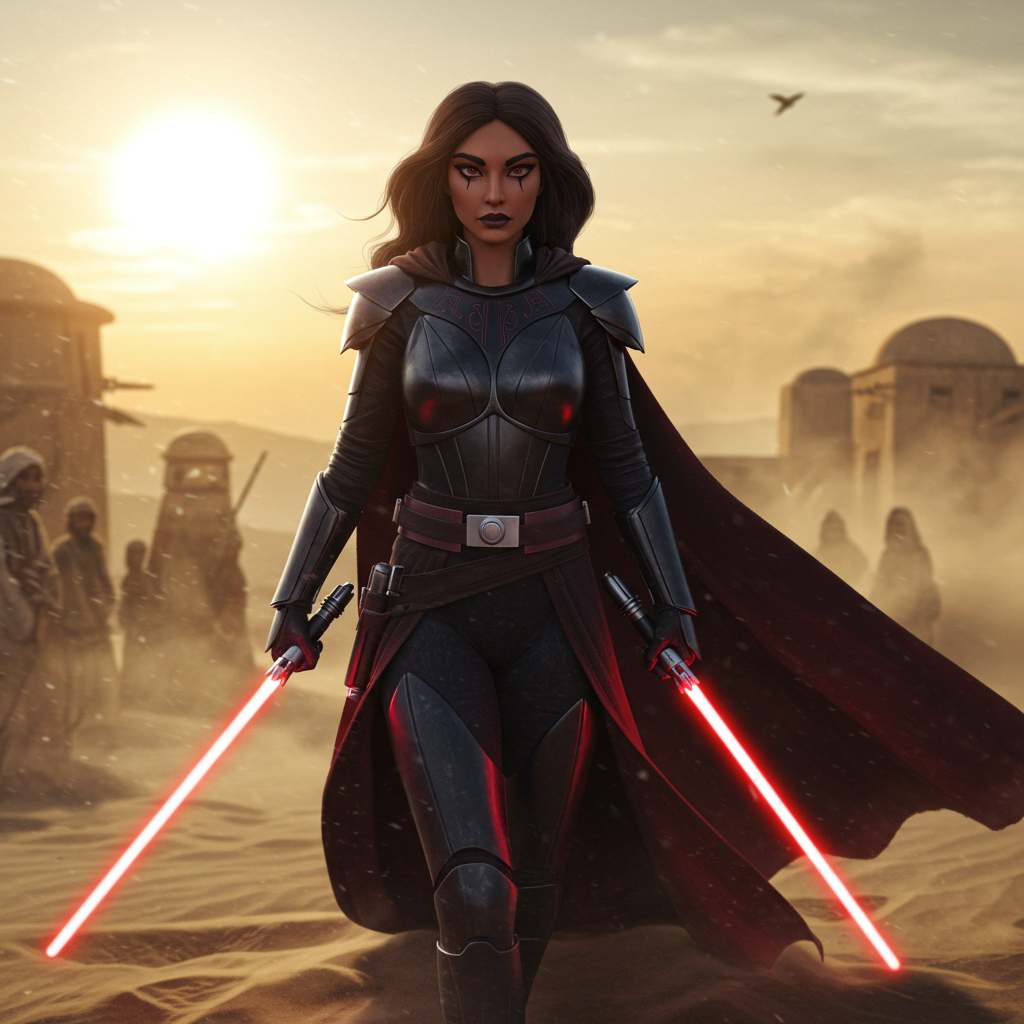
This artistic vision crafts a 3D cinematic render that is both visually stunning and thematically rich. It portrays Jasmine under the iconic twin suns of Tatooine, standing amidst swirling sand, bathed in a dramatic, high-contrast golden light. This immediate juxtaposition of her royal origins with the grit of the Star Wars galaxy’s outer rim sets a powerful stage.
The character design is a masterful blend of familiar elements and radical transformation. Jasmine’s signature long, thick hair is retained but darkened, subtly tinted with red, and stylized into heavy, flowing loops that suggest both grace and weight. Her face, while retaining realistic features – a smooth tan complexion, large almond-shaped eyes with sharp winged eyeliner, finely arched brows, and full violet lips – is given a cold, commanding, and intense expression, replacing her characteristic warmth and curiosity with the focused power of the Dark Side.
Her attire is a direct nod to Sith lore while incorporating elements of her royal bearing. She wears a form-fitting matte black Sith Inquisitor bodysuit, accented with faint red glows along the seams, suggesting infused Dark Side energy. Armor plating features smooth, angular contours with subtle ornamental etching, a design that is both militaristic and subtly feminine. Sharp pauldrons protect her shoulders, and a dark alloy chestplate is adorned with intricate gothic motifs, hinting at a noble or even royal background beneath the dark exterior.
The details further cement her identity. A double-bladed red lightsaber, the weapon of choice for many Inquisitors, hangs menacingly at her hip, unignited but emanating a faint glow. Her high-slit cape, lined with deep crimson, billows dramatically in the desert wind, adding to the sense of movement and power. A utility belt with metallic detailing completes the look, holding the saber hilt and suggesting practicality within her dark elegance.
The background is not merely static scenery but an integral part of the narrative. A dusty desert village, partially obscured by the windblown sand, lies behind her. Frightened villagers watch from doorways, their presence underscoring the fear and power emanating from this dark figure. Her silhouette, framed by the low-hanging twin suns and drifting atmospheric haze, creates dramatic shadows and warm lens flares, enhancing the cinematic feel.
The artistic style emphasizes realistic textures – the grain of fabric, the polish of metal, the subtle pulse of glowing energy seams, the weathered look of leather. The lighting is intentionally cinematic, employing high contrast, visible sun-flares, dust motes caught in the light, and a warm ambient bloom. This approach aims for a look similar to high-end Star Wars concept art or a still pulled directly from a next-generation cinematic cutscene.
This concept is more than just a visual mashup; it’s a fascinating exploration of a character’s potential path if exposed to different forces. It challenges the audience to imagine what could drive a princess of Agrabah down the path of the Dark Side and how her inherent strength and independence might manifest as Sith power. It’s a testament to the creative possibilities unlocked when beloved fictional universes collide.